The science & the scientists
Why Nowa is built this way.
The main page shows what Nowa is. This is the reasoning underneath: four deliberate decisions, and our advisors’ fingerprints on all four.





Decision 01 · The gameplay
A pet, not a slot machine.
Most apps hold a child’s attention by shrinking the loop: tap, reward, tap again. Nowa runs on the opposite loop. The design problem we set ourselves was keeping that fun.
The loop most apps run
Tap→Treat→Tap again



Cycle: seconds
Instant reward, refilled instantly, so the child keeps tapping.
The loop Nowa runs
Care→Wait→Grow

Cycle: hours & days
Care pays off slowly, the way living things grow. Waiting is simply part of the play.
Raising a pet is the one game where the slow loop is the fun part. The payoff is a creature that grows because your child kept showing up. The wait is not a flaw in the game.
The wait is the skill.

Fun enough to come back to. Calm enough to put down.
 Fun
 Calm
That is the whole design brief. We know what screens do to young attention, and we know a toy nobody plays with teaches nothing. The gameplay lives on that line, and Dr. Steven Kurtz shaped how the pet holds it: greet before asking, praise the trying, never demand out of nowhere.
“The science of parent training consistently shows that children develop responsibility through guided practice within a supportive relationship. When parents are actively involved—coaching, reinforcing, and sharing in the process—children don’t just comply in the moment; they build the internal skills needed to manage themselves over time. Nowa provides this guided opportunity.”
Dr. Steven Kurtz
Parent-child interaction · President, Kurtz Psychology Consulting
Decision 02 · The missions
Nothing in the library is there on a hunch.
Missions are what your child actually practices: three skill areas, each led by the advisor who helped write its science.
 Habits & routinesDr. Steven Kurtz
 Emotional skillsDr. Susanne Denham
 Focus & self-controlDr. Megan McClelland
Here is one mission, walked back to where it came from.
-
What your child hears
It happens to the pet, not the child. Nobody is being tested. Somebody needs help.
Mission EQ-047 · The Knocked-Over Tower
“Miko went quiet. Pip crashed into the tower Miko spent all morning building. Look at Miko’s face. What do you think Miko is feeling right now?”
Twenty-six words. Here is where every one of them came from.
-
The paper behind it
Every mission starts in our activity catalog, with its source attached.
- Entry
- Activity #041 · hard moments with friends
- Source
- The Challenging Situations Task: Denham, Way, Kalb, Warren-Khot & Bassett, British Journal of Developmental Psychology (2013), a validated measure of how children read feelings and choose responses
- Skill
- Emotion knowledge · social problem-solving
- Original age
- Preschool and up, per the source research
- License
- Public domain via the CASEL catalog · adapted within its terms
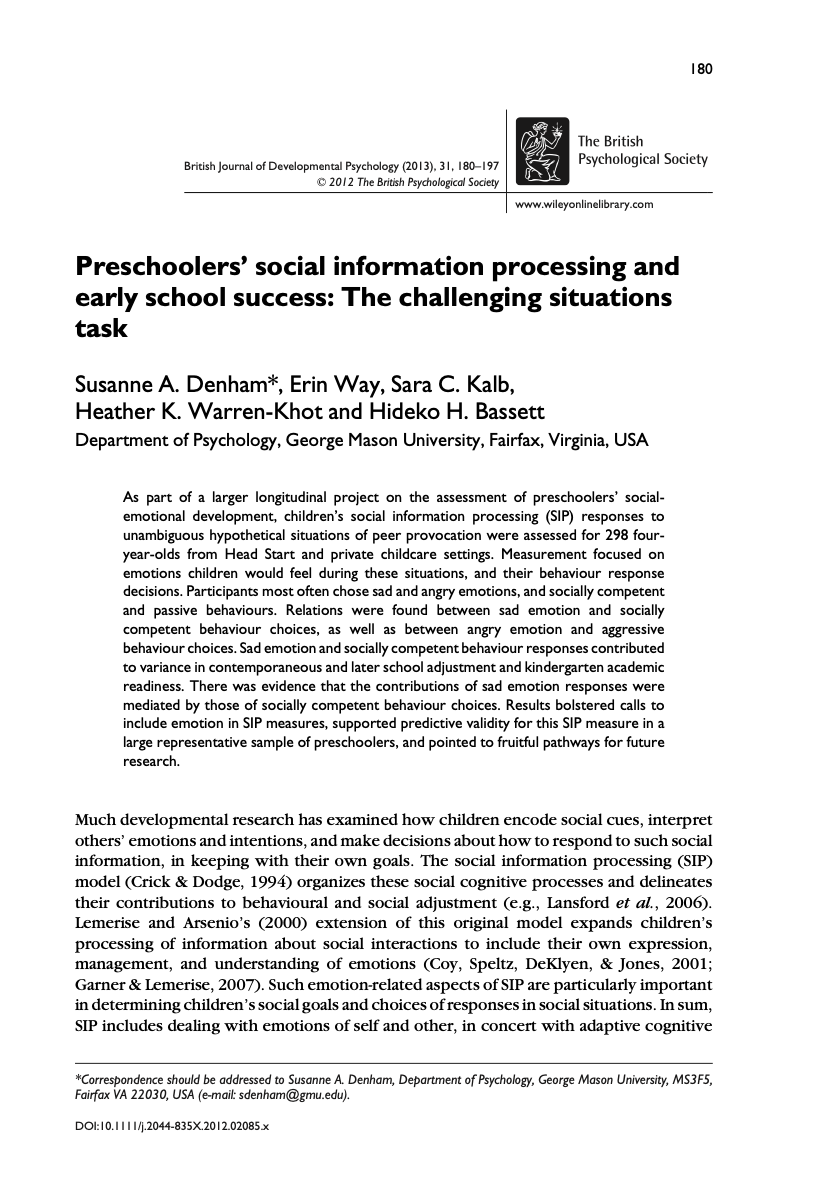
Page 180 of the study, as published. The ruleNo web searches, no shortcuts: 30+ documented sources, read in full, logged with citations. Protected measures are never copied.
-
The same mission, two ages
One idea, written twice, because age four and age eight are different minds.
Age 4“Miko is sad. Pip broke Miko’s tower. Should Miko take a big dragon breath, or ask Pip to help rebuild it?”
Two choices, one feeling, heavy help from the pet.
Age 8“How do you think Miko feels? And what could Miko say to Pip, so tomorrow goes better?”
Open questions, another point of view, a social fix to reason out.
“Children develop executive function and self-regulation when they are interested and engaged. When children care about something, they are more likely to practice skills that help them be self-regulated and successful in school and life.”
Dr. Megan McClelland
Executive function · Professor, Oregon State University
-
The red pen
Before a mission ships, the advisor whose field it sits in marks it up.
“What would you do? Find someone else to play with, or ask another friend?”“What would you do next? You could find a new friend to play with, or you could play something fun by yourself. Which one?”“…seem the same, or very close. Shouldn’t these be different actions to choose from?”
Dr. Denham’s review note on mission “Bobby Said No”The recordDr. Denham’s last review returned 20+ notes. Dr. McClelland flagged a copyright issue; we rebuilt those missions. Dr. Kurtz wrote the pet’s warm-up rules.
The library’s growth. Each step is an advisor review cycle.
Every one of the 150+ missions can make this same walk: mission to activity, activity to paper, paper to advisor.
“Children primarily build emotional competence through consistent, safe relationships where naming and navigating feelings happen naturally, every day. That kind of relational practice is what the research consistently points to as most effective in early childhood. Such emotional competence accrues lifetime benefits.”
Dr. Susanne Denham
Emotional competence · Professor Emerita, George Mason University
Decision 03 · What comes back to you
The play comes back to you as insight.
As your child plays, the app builds a picture of their development: which feelings they can name, where focus slips, which routines are sticking. Our advisors decide what is worth showing you at each age, and pair it with what to do next.

Your Nowa appOne month in
Mai named a feeling out loud, unprompted, four times this month. Last month, that number was zero.

Try tonightChildren her age often go quiet about anger next. When it shows up, try naming it before you fix it.
A clear view of where your child is, and one practical thing to try tonight. The goal is to make you better at this too.
In development
Being shaped now with Dr. Denham, Dr. McClelland and Dr. Kurtz: which signals matter at each age, and what advice actually helps.
Decision 04 · What it must never become
A pet that sparks imagination, not one that replaces it.
You have met the other kind of toy: the companion that chats back, always agreeable. Nowa’s pet never speaks your child’s language. It chirps, sulks, celebrates, and waits to be understood.
So your child has to read it. Is that a hungry sound or a lonely one? A friend who answers everything leaves nothing to figure out.

♪ prrp… prrp! ♪

Three children heard it
“He’s hungry. He always sings like that before dinner.”
“She heard me come home. She missed me.”
“That’s his happy sound. It goes up at the end when he’s happy.”
One sound, three theories, all of them the child’s own.
This is also the safety design. With no open-ended conversation, there is no conversation to go wrong. What your child hears is sound and feeling, reviewed by the people on this page, and nothing else.
“Social media ran a decade-long experiment on children’s attention, and we know how that went. Companion AI could run the next one on something deeper, attachment, because a chatbot that talks back and flatters will win a child’s bond whether or not it is good for them. I still believe AI can be a force for good in children’s lives, but only when it is intentional by design about the outcome it serves. This pet cannot chat, does not flatter, and does not harvest attention. It sends a child back to play, to people, to their own imagination. That is why I am here.”
Dr. David Mou
Mental-health systems · CEO, Benchmark Health Group
The standard
The rules we hold ourselves to.
- 01No mission without a paper behind it.
- 02Warm before we ask.
- 03Credit for trying, never scores on the child.
- 04Slow loops, on purpose.
- 05Sound and feeling, never chat.
Our advisors’ job is to push back, and they do. Working relationships, not names on a page. If you go looking, we want you to find that it holds.
Ready to meet Nowa?
In stock, ships from the US·Free shipping on every bundle